














http://www.pambazuka.org/images/articles/372/48212zimbabwe-police.jpgArg... that Mugabe has been "talking left" while "walking right" Grace Kwinjeh analyses Zimbabwe through regional, African and global capitalism.
The post election crisis in Zimbabwe and the SADC region is a manifestation of much deeper, complex issues to do with global capitalism and its vampire-like tendencies.
At the root of the problems is the failure of our nationalist governments to deal with these dimensions of the global crisis: food shortages and price hikes; oil speculation; financial meltdowns and higher interest rates. These manifest themselves as rising inequality and unemployment and competition between very poor people in places like Alexandra, Tembisa, Diepkloof and the Johannesburg inner city for scarce resources.
It is only by addressing these issues that we can meet the aspirations of the masses for freedom and decent lives.
Forces both local and global may seem to be worlds apart in the definition and context of the Zimbabwean struggle but we African citizens are all in an awkward position.
GLOBAL CAPITALISM
While we are fighting the Robert Mugabe dictatorship, we Zimbabweans have not been spared from the negative impact of global capitalism on our livelihoods especially in poor communities - as we are currently witnessing, in the current xenophobic attacks against us in South Africa.
The xenophobia exposes not only working-class people's fears of lower wages, higher crime and new cultural influences, as is the explanation at first blush. In addition, we can see in the attacks on non-nationals the duplicitous role our national elites play in pushing us further to the mercy of capitalist forces while they label us in the opposition – puppets of the West.
The attacks are being condemned by progressive forces in SA, including COSATU Secretary General, Zwelinzima Vavi, who said: "I want to send out this message: It is not the Zimbabweans (exiles) that cause the problems (of the poor)".
He cited the capitalist system as the problem and argued that South Africa should focus on building an economic system that could: "seriously eradicate poverty".
The same position reiterated by the Anti-Privatisation Forum:"Let us not forget that it is South African corporate capital – through the framework of NEPAD – that has, over the last decade, moved into other African countries, most often causing many local, smaller businesses to close down and thus contributing to a situation in which many poor people have lost their jobs."
THREE MILLION EXILES
There are over three million of us eking out a living outside Zimbabwe's borders, a result of the failure of our national leaders to deliver both politically and economically for us at home. The situation gets more ridiculous when looked at within the context of the aspirations spelt out in the reformed African Union, in the New Partnership for Africa's Development, and its dream of an African Renaissance.
These programmes are again full of empty rhetoric framed, more to attract international donor funds and less to deliver dignity to African citizens, negating our 'ubuntuness', which espouses values to do with compassion, value for human life, respect for each other and harmonious existence.
Even as Frantz Fanon prophesied back then on the dilemma of African Unity in post–colonial Africa: "Now the nationalist bourgeois, who in region after region hasten to make their own fortunes and to set up a national system of exploitation, do their utmost to put obstacles in the path of this 'Utopia'. The national bourgeoisies, who are quite clear as to what their objectives are, have decided to bar the way to that unity, to that coordinated effort on the part of two hundred and fifty million men to triumph over stupidity, hunger and inhumanity at one and the same time."
Fanon’s insight helps us understand the failures of Mugabe and his allies beyond their “leftist” rhetoric. They are forever trapped in the awkward “talk left – walk right” jive as they remain arguably the best custodians of capitalist/imperialist forces, in our countries.
Mugabe flirted with the US military for many years, and until 1998 was considered amongst the highest-performing of World Bank and International Monetary Fund puppets, earning a "highly satisfactory" rating from the Bretton Woods Institutions in 1995. Did he not use $205 million in hard currency in 2006 to repay the IMF for failed loans?
In Zimbabwe today those suffering under the yoke of Mugabe's oppression are us black citizens. We are the homeless, the jobless, the battered and the bruised.
MAJORITY NOT RESPECTED
We are in the majority of those whose vote is not respected, in a negation of that very national liberation struggle aspirations of 'one man one vote.'
At the moment, Zimbabweans are just as good as people who did not go out to vote. We remain at the mercy of the dictatorship, as Mugabe is determined at each turn to reverse our hard-earned victories.
The elections did not deliver change. Instead, the moment of triumph against Mugabe and his cohort soon turned into a nightmare. The opposition won against one of the most entrenched liberation movements on the African continent. We romped to victory with a narrow parliamentary majority, equal seats as Zanu PF in the Senate and a majority votes in the Presidential election count. It was a great achievement given the odds placed against any possible opposition electoral victory.
DEVASTATING RETRIBUTION
“One group grabbed a 79-year-old widow, yanked up her skirt, then lashed her bare buttocks with barbed-wire whips as two dozen terrified relatives looked on. The woman, Martha Mucheto, said she cried in pain and shame. ‘If none of you confesses, we will hit this granny until she's dead,’ Mucheto, a great-grandmother and former nurse's aide, recalled hearing. She spoke from a hospital bed in Harare.”
The story of Mugabe's retribution against innocent civilians gets more devastating each day – from abductions, torture to cold blooded gruesome murders.
Old grannies such as gogo Mucheto are not spared in this brutality. Young men are killed in cold blood. The latest case is of Better Chokururama who was shot once and stabbed four times around the chest area by Mugabe's thugs. Chokururama was buried on 17 May 2008, one of at least two dozen MDC members killed for their beliefs in recent weeks, and one of several hundred since 2000.
Most affected are the already-struggling and impoverished rural folks. Scores are being displaced our national leaders to deliver both politically and economically for us at home. The situation gets more ridiculous when looked at within the context of the aspirations spelt out in the reformed African Union, in the New Partnership for Africa's Development, and its dream of an African Renaissance.
MAJORITY NOT RESPECTED
We are in the majority of those whose vote is not respected, in a negation of that very national liberation struggle aspirations of 'one man one vote.'
At the moment, Zimbabweans are just as good as people who did not go out to vote. We remain at the mercy of the dictatorship, as Mugabe is determined at each turn to reverse our hard-earned victories.
The elections did not deliver change. Instead, the moment of triumph against Mugabe and his cohort soon turned into a nightmare. The opposition won in their own areas while others find their way to towns, many being victims of torture.
Zanu PF, the liberation movement that defeated the colonialists in a protracted struggle, somehow concluded that they should hold state power in perpetuity. The era of democratization has not yet arrived. The elites in Zimbabwe, like their despotic friends elsewhere in the world, disdain the notion that elections are the process through which people elect leaders of their choice.
Elections remain a privilege that is denied to the masses. As Zimbabwe prepares for a run-off on the 27th of June, we expect once again to be fed nauseating fascist propaganda on good citizenry and patriotism. Mugabe has declared war against the people of the world.
We have an obligation to organize ourselves and fight back. As Fanon advised: "…we must understand that African Unity can only be achieved through the upward thrust of the people, and under the leadership of the people, and that is to say, in defiance of the interests of the bourgeoisie."
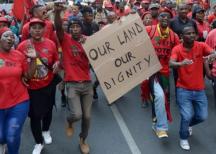
The marches on 17 May 2008, led by COSATU, helped to strengthen people-to-people solidarity. The way our SATAWU comrades exposed and fought against the 'ship of shame' and stopped it from offloading its cargo of arms in Durban, is a show of solidarity that the people of Zimbabwe will forever remember.
Zimbabwe does not need arms. We are not at war. We want decent jobs, homes, schools and food.
*Grace Kwinjeh is an NEC member of the MDC and the Chairperson of the Global Zimbabwe Forum.
**Please send comments to or comment online at http://www.pambazuka.org/
- Log in to post comments
- 1231 reads
Author

Anonymous (not verified)